If you have searched for an "IELTS band score calculator", you have probably found several different conversion tables that disagree with each other. This post explains what IELTS itself publishes about scoring, what it does not publish, and how to use that to get a realistic idea of your level.
The short version
- Listening and Reading each have 40 questions, worth 1 mark each. Your mark out of 40 is converted to a band from 1 to 9.
- Writing and Speaking are marked by examiners against four criteria each, weighted equally.
- Your overall band is the average of the four section bands, rounded to the nearest half band.
- IELTS only publishes average marks for a few bands. The exact marks you need change slightly from one test version to the next, so any full conversion table is an estimate.
Listening: marks out of 40 to a band
The official IELTS site says: "The IELTS Listening test contains 40 questions. Each correct answer is awarded 1 mark. Scores out of 40 are converted to the IELTS 9-band scale. Scores are reported in whole and half bands."
It then gives the average marks scored at four levels:
| Band | Average Listening marks (out of 40) |
|---|---|
| 5 | 16 |
| 6 | 23 |
| 7 | 30 |
| 8 | 35 |
The same page adds: "The precise number of marks needed to achieve these band scores will vary slightly from test version to test version." So 30 out of 40 is roughly where Band 7 sits on average. It is not a fixed cut-off.
Reading: Academic and General Training are not the same
Reading also has 40 one-mark questions, and both versions are reported on the same 9-band scale. But IELTS states that "It is usual that a greater number of questions must be answered correctly on a General Training Reading test to secure a given band score." The Academic test "may contain texts which feature more difficult vocabulary or greater complexity of style."
| Average Reading marks (out of 40) | Academic band | General Training band |
|---|---|---|
| 15 | 5 | 4 |
| 23 | 6 | 5 |
| 30 | 7 | 6 |
| 35 | 8 | 7 |
Look at the same raw mark across the two columns. 30 correct answers is about Band 7 in Academic but about Band 6 in General Training. If you take General Training and use an Academic table, it will likely show a band about one level higher than you would get.
Why every "complete" conversion table is an estimate
IELTS publishes only the four average points shown above for each test. It does not publish an official mark-by-mark table, and it says the marks needed vary between test versions. Any table that lists every mark from 0 to 40 has been filled in by someone between those points, so read it as a guide, not a guarantee.
In practice: if a calculator says you are Band 7 with exactly 30 correct, you are at the average mark for Band 7, not safely above it. Aim for a few marks of margin on top of whatever band you need.
Writing and Speaking: four criteria each
Writing is marked on four criteria:
- Task achievement (Task 1) or task response (Task 2)
- Coherence and cohesion
- Lexical resource
- Grammatical range and accuracy
IELTS says each task is assessed on its own, the criteria are weighted equally, and "The assessment of Task 2 carries more weight in marking than Task 1." The official page does not give the exact weighting between the two tasks, so treat any precise split you see online with care.
Speaking is marked on fluency and coherence, lexical resource, grammatical range and accuracy, and pronunciation. According to IELTS, "Each of the criteria carry equal weighting and the overall average gives the IELTS score for Speaking."
Your overall band: the rounding rule
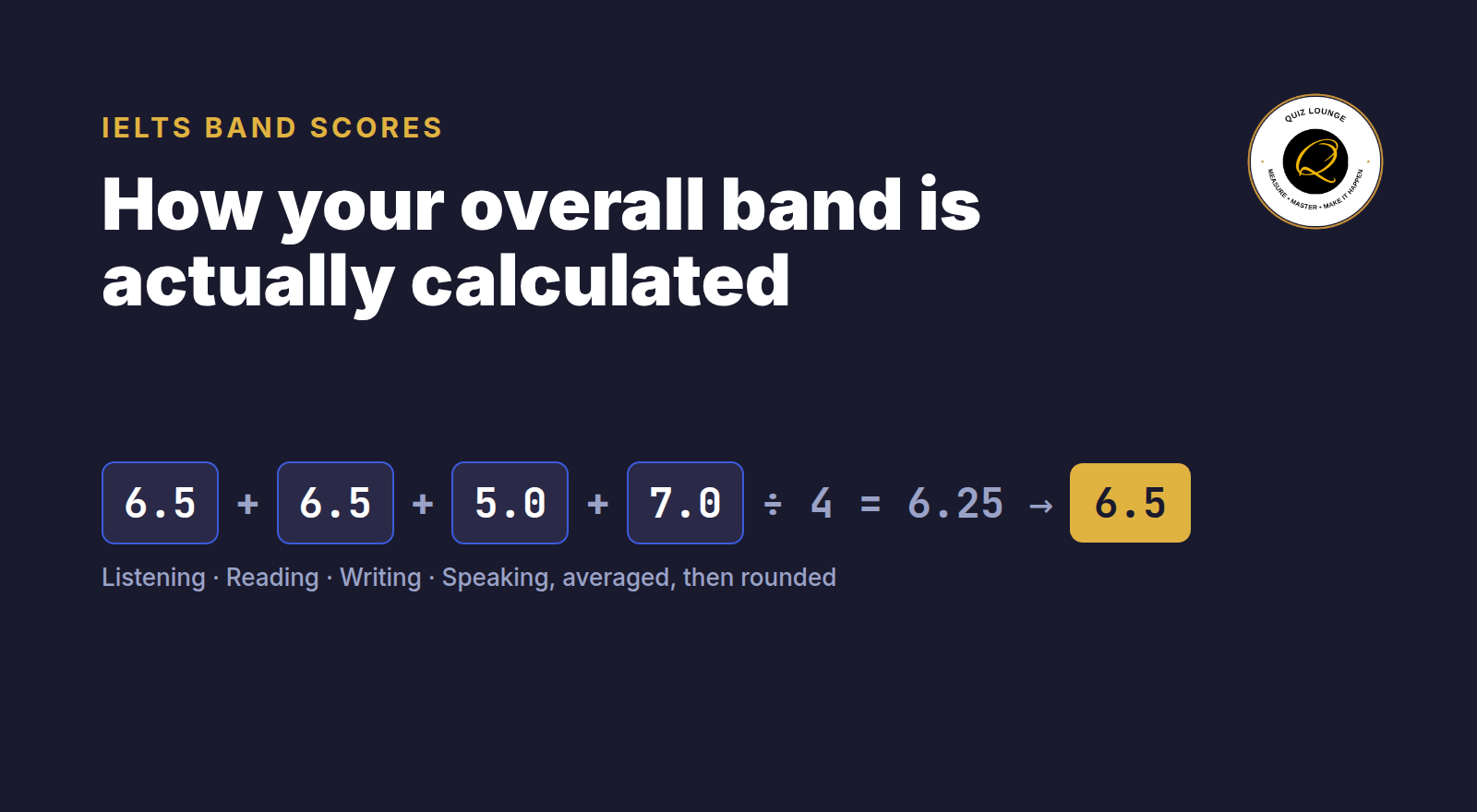
The official rule: "The overall band score is the average of the four section band scores rounded to the nearest half band." IELTS adds: "If the average of the four sections ends in .25, the overall band score is rounded up to the next half band, and if it ends in .75, the overall band score is rounded up to the next whole band."
These are the worked examples IELTS gives itself:
| Listening | Reading | Writing | Speaking | Average | Overall band |
|---|---|---|---|---|---|
| 6.5 | 6.5 | 5.0 | 7.0 | 6.25 | 6.5 |
| 4.0 | 3.5 | 4.0 | 4.0 | 3.875 | 4.0 |
| 6.5 | 6.5 | 5.5 | 6.0 | 6.125 | 6.0 |
Two things follow from this:
- One section can pull you up or down by half a band. In the first row a weak Writing score (5.0) still ends at an overall 6.5, because 6.25 rounds up. In the third row the average is 6.125, which rounds down to 6.0.
- Check whether your target also sets a minimum for each section. Ask the university, employer or immigration body you are applying to for its exact requirement, because a good overall band will not help if they also have a per-section minimum and one of your sections falls short.
How long does a score last?
IELTS says: "We recommend that IELTS test results are considered valid for two years after a test has been taken." Organisations can accept older results if they choose, so check with them directly.
Use the numbers, not the guesswork
A conversion table can only tell you roughly what a raw mark is worth. To know where you actually stand, you need a real mark from a timed set of questions, and then you compare it with the average points above.
Next step: take QuizLounge's free IELTS Reading diagnostic: 20 IELTS-style questions in about 20 minutes, with a band estimate and a breakdown by question type. It is a short diagnostic, not a full 60-minute mock, and you only need an email address, with no card. Already have raw marks from a practice test? Put them into the band score calculator, and keep the margin advice above in mind.
Sources: IELTS, "IELTS scoring in detail" (ielts.org) and IDP IELTS, "Understand IELTS scores" (ielts.idp.com), both accessed 20 October 2026.